
广告
You’ll learn simple habits that change how your team feels and performs. The idea of active reflection leadership shows the importance of short, regular reviews. Harvard Business School frames a useful model: Awareness, Judgment, Action, and Reflection.
Many people leave jobs because they don’t feel seen. Zippia reports that 79% quit for that reason and only 33% feel engaged. That gap makes a clear case for better practice.
With reflective leadership, you sharpen your 战略 and make smarter calls for your organizations. Small routines — even five-minute reviews — help leaders learn, stay grounded, and guide teams with more confidence.
This guide shows practical steps you can use now. You’ll see how reflective habits build trust, lift retention, and drive visible 结果 和 生长 without extra complexity.
Why pausing to reflect is your strategic advantage today
When you give yourself space to think, your choices become clearer and more strategic. Short pauses turn what feels like a soft skill into a measurable edge for your team.
广告
Harvard Business research frames this as a continuous practice that strengthens awareness, judgment, and action over time. Weekly five-minute decision reviews, for example, sharpen thinking without adding burden.
You reduce bias and reactivity by building a tiny habit. That improves your decisions and supports better overall performance.
- You gain a strategic edge by avoiding reactionary thinking and weighing multiple angles.
- You improve outcomes without needing more 时间, using brief, consistent moments of clear thinking.
- Quick decision reviews help you note what worked, what to change, and what to repeat.
Over weeks, these small checks compound into smarter strategy and make your team feel more supported. You’ll show up more present and intentional when it matters most.
广告
What active reflection leadership is and how it differs from “just thinking”
Not all thought is useful—skilled reflection turns questions into clear next steps. You can treat reflective leadership as a practical framework that guides how you see, decide, act, and learn.
The reflective leadership model: Awareness, Judgment, Action, Reflection
The Harvard Business School model offers four simple moves: awareness, judgment, action, and reflection. Professor Nien-hê Hsieh stresses that ongoing review helps you re-evaluate decisions and deepen your skills.
Skilled reflection vs. rumination: turning insight into action
Skilled reflection focuses on options and next steps. Csikszentmihalyi warns that unskilled self-focus can worsen mood and stall progress. Use prompts that produce choice, not loops.
From theory to practice: reflective habits across organizations
Organizations that make this work set clear rhythms: decision reviews, coaching, and short learning routines. These habits convert insight into changed behavior and better results.
- Define the model so your team links thought to action.
- Spot rumination early and reframe it into an option list.
- Build simple prompts that grow skills and steady practice.
Use this concise theory to shape daily habits. Over time, your team will act with more clarity and purpose.
The importance of reflective leadership for better decisions and stronger teams
Good decision habits let you spot bias before it shapes a call. This practice improves ethical judgment and helps you align choices with your values.
Better decisions: reducing bias and improving ethical judgment
You improve decision quality when you pause to test assumptions, consider stakeholders, and check for blind spots. Short weekly decision reviews and five-minute reflections turn raw experience into clear knowledge.
Adaptability and growth: learning from experience in real time
When you convert recent work into quick lessons, you expand your ability to adapt. Coaching and peer feedback create fresh insights you can apply immediately.
Engagement and trust: how reflection lifts team performance and culture
Self-aware leaders foster trust, which ties directly to stronger performance. Share what you learn, invite input from others, and you build capacity across the team.
- Test assumptions and align choices with values to improve outcomes.
- Turn short reviews into knowledge that informs your next move.
- Model reflective routines so leaders at every level can contribute.
- Close the loop between intent and result to boost trust and engagement.
Active reflection leadership in practice: a simple, repeatable process
A short, repeatable loop can turn messy experience into clear, useful lessons. Use a compact rhythm so you capture learning from recent work and turn it into better strategy for the next action.
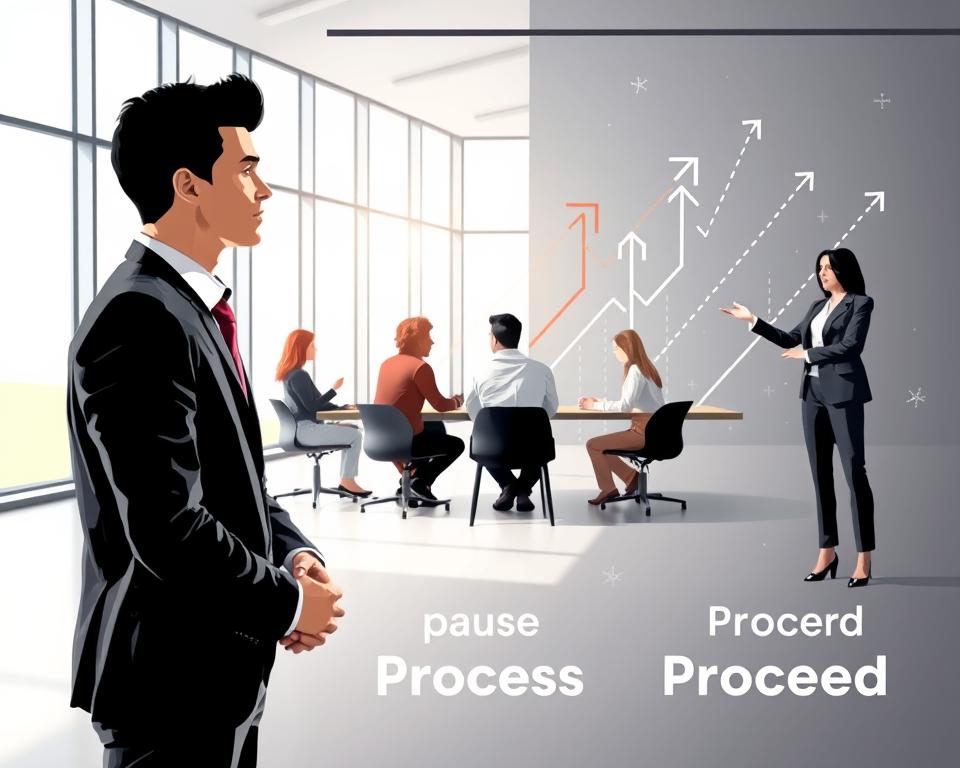
Pause-Process-Proceed: building a leadership rhythm
Pause to step back. Take two minutes to name what happened and why.
Process the facts, pick one insight, and agree on one concrete action. Then proceed with a sharper plan.
Get to the balcony: see system patterns
Step out of the fray so you can spot patterns, risks, and interdependencies that are invisible in the heat of action.
That space helps you link individual experiences to team-level change and avoid repeating mistakes.
Single-loop vs. double-loop learning: upgrade how you learn
Single-loop learning tweaks actions. Double-loop learning questions your model and goals.
Use short debriefs after key experiences to connect insights to process, cadence, or ownership so lessons stick.
- Operationalize this process with scheduled pauses before and after critical moments.
- Make thinking visible so your team helps refine actions and strategy.
- Shift from ad hoc reactions to a deliberate loop that compounds learning.
Tools and routines to make reflection a daily leadership habit
Tools that fit your schedule make it easier to learn from each decision. Use small, repeatable practices so you get better without long meetings or extra 时间.
Leadership journaling: five-minute decision reviews and lessons learned
Start a five-minute journal to capture choices, brief lessons, and follow-ups. This turns everyday work into reusable knowledge you can act on.
Feedback loops and peer reflection: mentorship, coaching, and Johari Window
Build peer check-ins and mentoring into existing routines. Use the Johari Window to surface blind spots and normalize honest feedback.
Simple prompts and models: 5 Whys, SWOT, Ladder of Inference
Keep three simple models at hand: the 5 Whys for root causes, SWOT to map strengths and gaps, and the Ladder of Inference to catch quick, flawed thinking.
Coaching partnerships: creating a reflective container for clarity
Create a coaching partnership that challenges assumptions and sharpens plans. Short, consistent sessions give you outside perspective without a big time cost.
- Quick journaling captures decisions and next steps in five minutes.
- Peer routines fold feedback into weekly check-ins to surface blind spots.
- Simple models help ask better 问题 and improve reasoning on the spot.
- Coaching turns insight into action and builds your reflection skills.
- Anchor these practices to daily or weekly rituals so the habit sticks.
With these tools and a steady practice, you will grow the skills your team needs and keep learning part of how you work.
Overcoming barriers: time, training, and the “action bias”
Most managers want to learn, but limited time and few tools hold them back. You can meet those challenges without long workshops or extra meetings.
从小事做起。 Stack five-minute practices onto things you already do—after a meeting, before a one-on-one, or at the end of the day. Short prompts like What mattered most today? 和 What would I change? focus your thoughts and stop unstructured self-focus from turning into rumination.
Start small: five-minute practices linked to existing routines
You’ll beat the time challenge by making reflection a micro-moment. These mini-checks require no calendar friction and build habit fast.
Shift the mindset: from constant motion to accountable action
Reframe pauses as a tool for faster, clearer action—not delay. Plan a brief pause before big decisions and ask one targeted question to counter action bias.
- Measure small experiments to grow capacity—track what changes and celebrate wins.
- Make it visible so leadership development becomes part of daily work, not a separate program.
- Center self-first so you can show up present and ready when stakes matter.
For evidence on how structured self-focus helps, see this structured self-focus research. Small, repeatable habits produce clarity and build your ability to lead consistent, accountable action.
From personal practice to team culture: scaling reflection across your organization
To scale thoughtful practice, you must turn private habits into shared team routines.
Rituals that stick: retros, after-action reviews, and decision debriefs
Anchor reflection in short retros, after-action reviews, and quick decision debriefs so learning lives inside delivery, not beside it.
Design a simple framework for debriefs: what happened, why, and what we will change. Keep each step focused and assign one owner.
Peer-led learning: communities of practice and cross-functional reviews
Encourage peer-led communities that trade tactics across teams. This spreads knowledge through organizations and reduces silos.
Leaders play a central role by sharing their own lessons and creating opportunities for others to practice.
Technology that helps: simple tools that create space, not noise
Choose lightweight tech: shared notes, brief templates, and gentle prompts that create space to think rather than add alerts.
Make outcomes visible—convert reflections into clear actions, assign owners and dates, and track small wins.
- You’ll anchor learning in team rituals so it becomes routine.
- You’ll empower leaders to model behavior and open sharing.
- You’ll launch peer groups that surface opportunities and avoid repeat errors.
- You’ll use simple tools that reduce friction and preserve focus.
For a usable method to guide group reviews, consider adopting a compact peer review framework. This helps teams turn brief reflection into steady improvement.
Measuring impact: how to track results from reflective leadership
Measuring what changes after short reviews tells you whether your habits actually move the needle. Pick a few clear signals so you can see early wins and long-run business effects.
Leading indicators to watch
Track early signals that show the practice is working. Watch decision quality, how fast teams learn, and psychological safety scores.
- Decision clarity: fewer reversals and clearer rationales in notes.
- Learning velocity: time from insight to experiment drops.
- Safety scores: more honest feedback and open questions in check-ins.
Lagging indicators that validate results
Use longer-term metrics to confirm real impact. Look at performance, retention, innovation output, and client outcomes.
- Improved performance and fewer avoidable errors over quarters.
- Higher retention as people feel seen and supported.
- More sustained innovation and better client results tied to tested experiments.
Convert insights into action with weekly decision reviews, structured debriefs, and shared notes. Capture knowledge in short docs, track how often experiments succeed, and connect those wins to development of new skills.
Review metrics regularly to keep habits aligned with team health and business growth. Over time, the patterns you analyze reveal the ROI of the practice and show where to scale or adapt.
结论
Make small habits your engine for better decisions and steadier teams. Use the Harvard Business School model—awareness, judgment, action, and reflection—as a quick guide. Pair short pauses with simple tools like journals, 5 Whys, debriefs, and coaching so insights become clear next steps.
You can balance thoughtful pause with decisive action so learning turns into measurable progress. Model the practice, invite others to join, and keep the process light so it fits your day.
Commit to small, consistent moves and you’ll expand your capacity to handle challenges, convert experiences into skill, and guide others with more clarity and purpose.