
Anúncios
You are about to get a fast, friendly look at how biomimicry turns nature’s time-tested designs into real-world solutions. This approach studies life’s patterns to solve human problems now.
In simple terms, learning from other species gives you practical clues for better design. You’ll see clear examples, from trains shaped like a kingfisher’s beak to turbine blades inspired by whales. These ideas cut waste, boost performance, and improve comfort.
Over the coming years, this way of thinking will scale across industries and around the world. You’ll leave this intro with a clear idea of how to reframe a challenge, find function-first clues in nature, and apply them to your next project.
What biomimicry means for you right now
Right now, nature offers tested tactics you can copy to cut energy, save water, and speed results. You’ll see concrete examples that prove the approach works at building and transport scales.
From nature’s playbook to real-world design
Biomimicry turns biological strategies into practical fixes. Buildings use about a third of global energy. Simple moves — like squid-skin-inspired dynamic panels — can simulate up to 43% total energy savings. The Eastgate Centre, modeled on termite mounds, trims heating and cooling loads by roughly 90%.
Anúncios
Why the present moment matters for climate, energy, and materials
When you map your problems to life’s patterns, you find fast, low-risk ways to act. Kingfisher-shaped noses cut train energy by 15% and lower noise. You can target one function at first — cool, filter, or manage light — to get pilots rolling in months, not years.
- Map a problem to a natural analog and borrow the control of air, water, or light.
- Prioritize materials and systems that lower climate risk without losing performance.
- Set time expectations: quick pilots versus longer R&D.
Biomimicry innovation across transportation and energy
Engineers are copying forms from birds, whales, sharks, and more to solve drag and power problems today. You’ll find clear examples that show how small shape or surface changes yield big returns in energy and performance.
Kingfisher-inspired trains: quieter, faster Shinkansen performance
An engineer, Eiji Nakatsu, adapted a kingfisher’s beak to reshape the Shinkansen nose. That new shape cut energy use ~15%, reduced tunnel booms, and raised speed by about 10%.
Anúncios
Humpback whale fins: tubercles boosting lift and cutting drag on turbines
Whale flipper tubercles guide flow to increase lift and lower drag—tests show up to 32% drag reduction and ~8% lift gain. Companies like WhalePower report ~20% more turbine power and longer component life.
V-formations of birds: formation flying concepts to save jet fuel
Researchers such as Ilan Kroo at Stanford proposed V-formation flight so aircraft use wingtip upwash to save fuel. Simulations suggest up to 15% fuel savings on long routes.
Sharkskin patterns: reducing drag on hulls and improving efficiency
Microscopic denticles break up eddies, lower drag, and resist fouling. You can apply similar textures to hulls, suits, or hospital surfaces to cut maintenance and improve efficiency.
- Practical takeaway: focus on flow control—shape and surface features manage turbulence, pressure, and boundary layers.
- Consider: trade-offs in manufacturing, coatings durability, and regulatory readiness before full deployment.
- transport and design examples provide deeper case studies you can explore.
Water wisdom from nature: harvesting, filtering, and mixing
Practical designs from plants and animals offer low-energy ways to collect and treat water you can deploy fast.
Fog harvesting from desert shells
The Namib desert beetle uses hydrophilic bumps and hydrophobic channels to pull moisture from air. You can copy that micro-scale patterning to harvest fog or reclaim condensate in arid sites.
Selective membranes inspired by aquaporins
Aquaporins move water while blocking salts, guiding low-energy filtration designs. Companies stabilize these channels with diatom-like silica to make durable, non-toxic membranes for real-world systems.
Spiral flows and plant forms for efficient mixing
Spiral mixers, inspired by lily shapes and natural vortices, reduce energy use by roughly 30% versus standard mixers. These geometries improve mixing while cutting the power that drives pumps and aeration—lowering carbon and operating cost.
- Quick wins: retrofit fog collectors or swap in spiral mixing modules.
- What to measure: recovery rate, pressure drop, and energy per gallon treated.
- Materials note: selective coatings and meshes enable targeted wetting and long service life.
Health and medicine inspired by organisms
Organisms teach us low-cost ways to make shots less painful and vaccines easier to move. You’ll find two clear paths that matter for clinics and field work.
Mosquito proboscis: less painful needles
Researchers led by M. K. Ramasubramanian et al. (2008) studied the mosquito proboscis and used that idea to design a three-pronged needle.
The result: insertion pain drops and patients report a gentler experience. This mechanical approach focuses on structure and surface chemistry to cut discomfort.
Anhydrobiotic strategies: vaccine storage without the cold chain
Some organisms survive long dry spells by stabilizing proteins. Nova Laboratories adapted that concept into a dehydration method using sugar syrups.
Vaccines can be dried, shipped, and later rehydrated at point of use. This addresses a core need—reliable access where refrigeration fails.
- What you can evaluate: mechanical design, rehydration kinetics, and regulatory fit.
- For people in the field: training, disposal, and compatibility with current delivery protocols matter.
- Pilot idea: partner with clinics to validate safety, usability, and logistical gains.
Materials that self-heal, stick underwater, and clean themselves
Smart materials are shifting how you repair structures, stick things underwater, and keep surfaces clean.
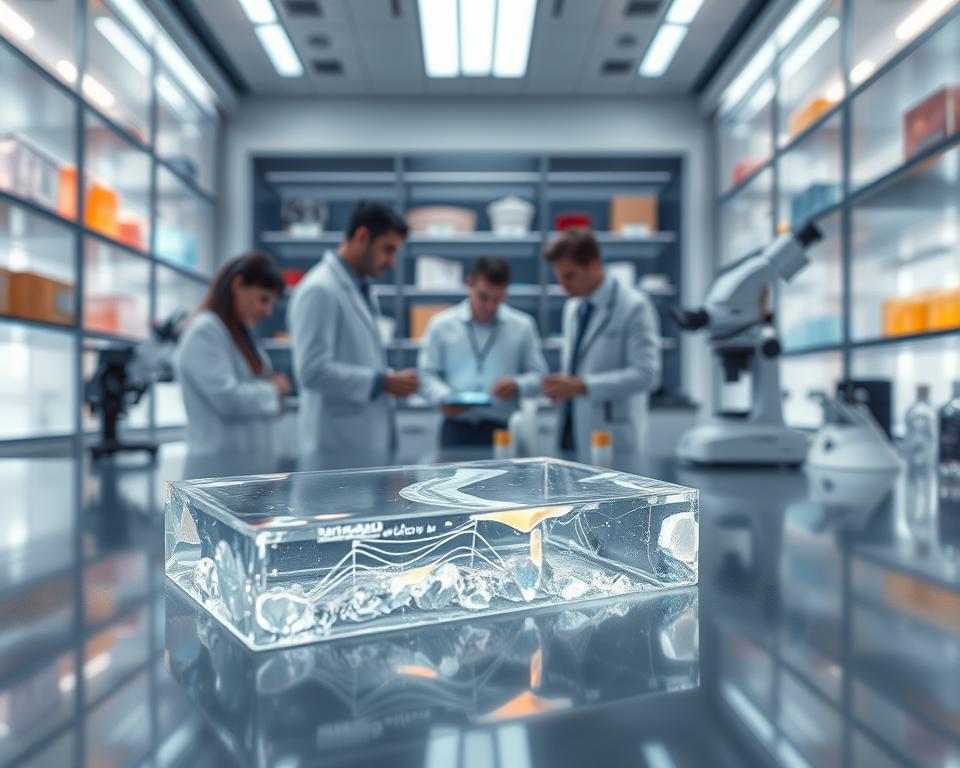
Bacillus bacteria: self-healing bio-concrete that saves time and carbon
Self-healing bio-concrete embeds limestone-producing bacteria spores. When cracks admit water and air, the microbes activate and precipitate calcium carbonate to fill gaps.
Benefit: fewer repairs, longer asset life, and lower carbon tied to maintenance (work by Hendrik M. Jonkers shows real-world gains).
Mussel chemistry: non-toxic, strong underwater adhesives
Mussel-inspired polymers mimic catechol chemistry to bond wet surfaces without toxic solvents. Firms like Mussel Polymers Inc. use this to repair reefs and hold marine fastenings.
Lotus effect and sharkskin: self-cleaning, anti-fouling, anti-bacterial surfaces
Micro-rough lotus coatings repel dirt; sharkskin denticles cut biofouling and bacterial adhesion. These materials reduce cleaning, water use, and harsh biocides in hygiene-critical spaces.
- What you’ll learn: how bacteria-activated repairs and catechol adhesives work in practice.
- Design note: key properties — porosity, micro-roughness, emissivity — drive function and test plans.
- Business impact: examples show extended service life, fewer shutdowns, and better operational efficiency on the P&L.
Everyday icons of nature-inspired design
A curious look at burrs on clothing led to a tiny mechanism that changed daily life. In 1941, Swiss engineer george mestral examined how burdock burrs latched onto fabric. That close observation became the idea behind Velcro’s hook-and-loop fastener.
From burrs to fasteners: a simple lesson
The hook-and-loop system made closures fast, reliable, and easy to use. Velcro showed up on apparel, shoes, medical straps, and aerospace gear.
- Field insight: a walk in nature sparked george mestral’s breakthrough that helped people open and secure things faster.
- Practical examples: use in shoes, gear, and safety devices proves the design scales.
- How you can apply it: capture quick observations, make a low-cost prototype, and test usability with customers.
Takeaway: small details can spark big product changes. Encourage curiosity on your team and turn field notes into working prototypes that customers value.
Buildings and cities that breathe and adapt
Cities and buildings can learn to breathe, using passive tricks to cut energy use and boost comfort.
Termite mound ventilation inspired a real-world example: the Eastgate Centre in Harare, designed by Mick Pearce. That system stabilizes indoor temperatures and cuts heating and cooling energy by about 90% versus conventional buildings.
You can apply the same systems in new builds or retrofits. Use thermal mass, well-placed vents, and nighttime flushing to move heat without heavy mechanical fans. These moves lower loads before you size active equipment and reduce operating costs for years.
From termite mounds to city networks
Slime mold logic offers another lesson. Atsushi Tero’s experiments used oat flakes as city points to replicate Tokyo’s rail layout. The resulting patterns suggest resilient, efficient transit and utility layouts you can test for your city.
- Practical moves: map problem nodes, test for redundancy, then adapt routes using nature’s heuristics.
- Where it fits: align designs with building codes and operations, and brief your company or facilities teams early.
- Why it works: the underlying science shows how flow networks minimize cost and risk—use that to justify choices to stakeholders.
Smart surfaces, color, and light
Smart surfaces are giving buildings and devices the ability to shift color and control light on demand. These systems tune heat gain and glare so you save energy and improve comfort.
Squid skin dynamics: tunable smart windows
University of Toronto panels use layered liquids to change hue and transparency. Simulations show up to 75% heating reduction, ~20% lighting savings, and about 43% total energy cuts in some cases.
That means retrofittable panels can deliver real efficiency while keeping clear views when you need them.
Gecko feet mechanics: residue-free reusable adhesives
Stanford teams reproduced van der Waals grip to make dry adhesives that stick firmly and release cleanly. These grips suit robotics, pick-and-place tools, and gentle medical interfaces.
- What you’ll learn: how color and light control translate into window and panel designs.
- Design tips: layered channels, controllable fluids, and micro-textured surface treatments preserve clarity and grip.
- Deployment checks: test durability, control systems, and maintenance before large rollouts.
Consider form and shape choices that keep function without cost. Translate the quick-switching ability of living skins into programmable materials for your next product or retrofit — small wings of change that scale well.
Food, agriculture, and circular systems
Perennial polycultures recreate prairie life to protect soil, save water, and steady yields over years. You’ll see how mixed, long-lived plantings cut irrigation needs and prevent erosion while boosting pest resistance and overall soil health.
Prairie ecosystems: perennial, polyculture agriculture for resilient yields
The Land Institute has shown that mimicking prairie systems lowers input needs and stabilizes output across seasons. Perennial roots hold soil, support microbial life, and reduce the need for heavy tillage or frequent fertilizers.
Benefit: less water use, lower carbon from reduced tillage, and crops that perform reliably across years.
Circular economy as ecosystem mimicry: turning waste into feedstock
A circular system routes byproducts back as inputs. Around the world companies turn tires into bags, sugarcane waste into packaging, and reclaimed wood into flooring.
- Where to start: pilot a supplier partnership to test recycled materials in packaging or product lines.
- Design tip: specify materials so they can be reclaimed and looped back as feedstock.
- Impact: reduce landfill waste, cut resource extraction, and lower lifecycle carbon.
These approaches give you practical solutions you can scale. Start with small plots or supplier pilots to de-risk change while building lasting material and system advantages.
How you can apply nature’s genius to your next project
Pick the concrete job your system must handle, then hunt nature for species that already excel at that job.
Define the function you need: filter, cool, adhere, or reduce drag
Start by naming the single function your project must do well—cooling, filtration, adhesion, or drag reduction.
Be specific: measure the target metric up front so tests answer clear questions.
Search for biological champions with the same function
Build a short list of natural analogs. Think aquaporins for filtration and termite mounds for passive cooling.
Work with researchers and domain experts to extract key patterns you can copy.
Translate patterns into testable design principles and prototypes
Turn patterns into simple experiments: textures, tubercles, or lotus-effect coatings at low fidelity first.
- Prototype fast: do bench tests that measure energy use, pressure drop, adhesion strength, or biofouling resistance.
- Align stakeholders: frame risk, cost, and benefits so approvals move quickly.
- Iterate and scale: use literature, databases, and collaborating researchers to refine designs, then plan manufacturing and system integration.
These practical ways let you use nature-inspired designs to solve real problems in less time. Treat each test as a learning loop and you’ll turn early wins into lasting solutions.
Conclusion
The patterns life uses—shapes, surfaces, and flows—map directly to clear, testable wins you can use today. You can reduce energy and carbon, improve water handling, and cut drag with low-risk pilots.
Start small: test a surface, a material, or a control rule and measure results. Companies already show how beaks, flippers, skins, and leaves translate into reliable technology.
Over the next years, the world will pull more value from these designs. Take one step now and your team will add steady gains in efficiency, resilience, and real impact.